
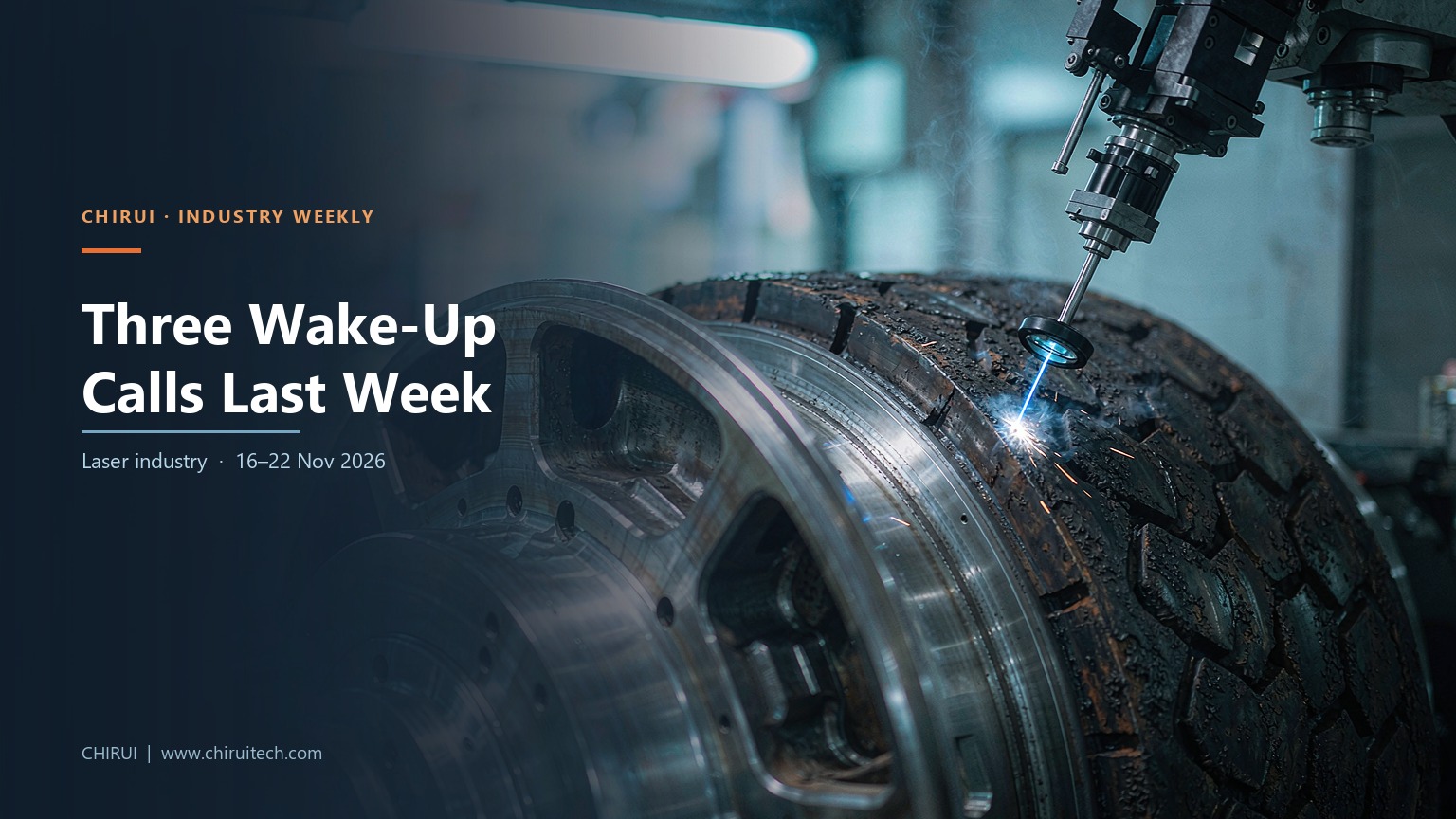
Last week (16–22 November) produced no blockbuster product launch. It produced three documents — a tender result, a national standard and an EU withdrawal notice. Read together, they say the same thing: laser cleaning is being repriced around proof of delivery and compliance, not wattage.
01 A tender result: buyers want an acceptance report, not a brighter gun
On 17 November, Shandong Energy’s Lunan branch published the award for its tire-mold laser cleaning project. Jiangsu Guoyuan Laser Intelligent Equipment won the contract, with a public notice period running 17–19 November. A week earlier, Guoyuan had been listed as the first-ranked candidate, with HGTECH’s Farley Laserlab second — the result now makes it official.
An industry commentary published the same week drew attention to a separate tender from AECC Southern Industry, dated 11 November: one laser cleaning system, with a “control system including an offline programming module” written into the equipment list. The commentator also noted requirements for at least one comparable installation in the previous 60 months backed by an acceptance report, no agents, six-month delivery and two-month commissioning.
That is still one commentator’s reading. But the direction is clear: buyers are moving from “who cleans fastest” to “who can deliver a repeatable, auditable process.”
02 A standard draws a line
MIIT Announcement No. 29 of 2026 (issued 10 November, widely republished last week) approved 796 industry standards, including JB/T 15748—2026, Technical Specification for Laser Cleaning Machines, effective 1 May 2027.
The standard covers industrial machines that remove rust, paint, oil and coatings from metal substrates — classification, technical requirements, test methods, inspection rules, marking, packaging, transport and storage. It explicitly excludes dedicated equipment for precision or functional surfaces such as optical components and semiconductor wafers.
That exclusion matters. Industrial rust removal now has a common benchmark, while wafer-level precision cleaning sits outside it — which leads directly to the fourth story below.
03 An EU withdrawal order: the interlock is not optional
On 19 November, EU Safety Gate alert SR/03352/26 recorded a compulsory withdrawal of a Chinese-made Depeng laser cleaning machine, notified by the Netherlands. The reason: no remote interlock to safely connect a laser enclosure. Operators and nearby staff could be exposed to direct, reflected or scattered radiation, causing irreversible eye injury and skin burns. The product was found non-compliant with the Machinery Directive.
Another laser cleaning machine, the UMW UC-P3, had been flagged for the same reason on 6 November. For anyone exporting to Europe, a remote interlock, an enclosure interface and documented conformity with EN 11553 / EN 60825-1 are moving from nice-to-have to entry ticket.
Based on the alert record; check the official Safety Gate entry for scope and current status.
04 Cleaning sold by yield, not by square meter
On 18 November, an industry commentary cited the November issue of Photonics Spectra: Femtum’s chief engineer Raphaël Dubé-Demers described dry post-cleaning and repair of photonic integrated circuits using 2.8 µm and 3.4 µm short-pulse mid-IR fiber lasers. Those wavelengths are strongly absorbed by oils and isopropyl-alcohol residues while leaving fragile photonic structures largely untouched. Cleaning was integrated with wafer-level laser trimming in one measure–trim–verify loop. The article reports Tier-1 customer validation and an oversubscribed USD 16 million funding round in March.
Here the unit of value is not square meters cleaned but good dies recovered. The commentator’s conclusion — that a handheld kilowatt rust remover has little to offer this customer — is an opinion, not a fact. The direction is still worth noting: in precision segments, cleaning becomes a yield tool.
Also on the radar
- Formnext 2026 ran 17–20 November in Frankfurt. Organizers cited 800+ exhibitors and more than 145 Chinese exhibitors. EOS launched HELIOR (three 70 W lasers, 154 L build volume, commercial availability from December); Nikon SLM Solutions unveiled MACHX with up to 8 kW of laser power.
- Bystronic received an Asia-Pacific regional headquarters certificate in Shanghai on 18 November. Han’s Laser announced completion of a roughly CNY 300 million share buyback on 19 November.
- On 21 November, Dier Laser won a CNY 4.5 million order for laser micro-hole and glass-etching equipment from Hubei Optical Valley Laboratory.
Three things to ask before you buy
- Ask about acceptance criteria first — cleanliness, roughness, material loss, heat-affected zone. Put them in the contract.
- If you export to Europe, check the interlock. A missing remote interlock can get a machine pulled off the market.
- Read the standard’s scope. JB/T 15748—2026 covers industrial metal cleaning; precision and wafer applications sit outside it.
Give us a sample, not a spec sheet. CHIRUI provides laser cleaning selection, test-clean evaluation and process validation.