
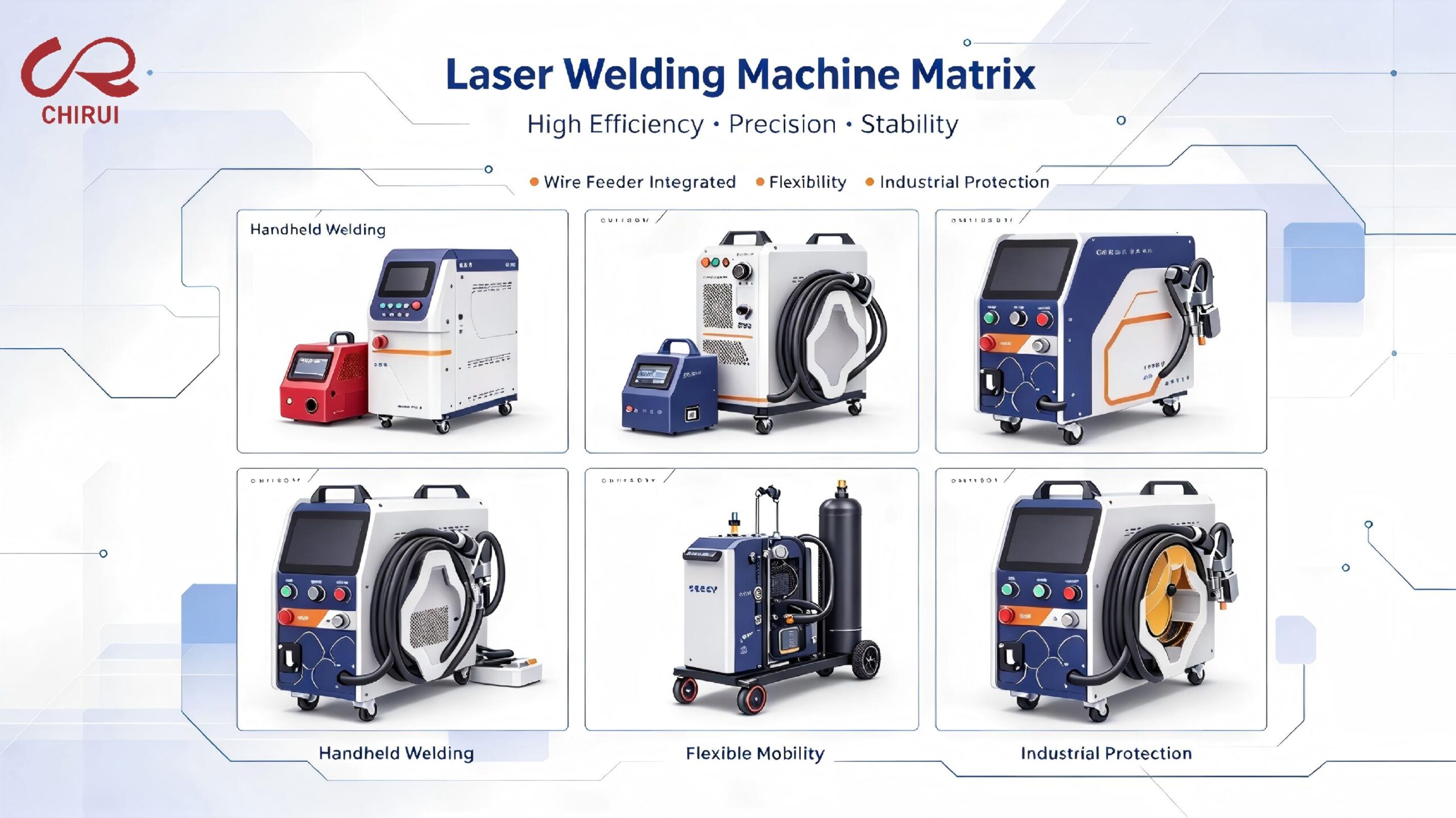
As laser welding becomes a standard process across precision sheet metal fabrication, steel structure manufacturing, automotive components, hardware products and new energy sectors, the quality of your equipment selection directly impacts weld finish, production efficiency, and total cost of ownership over the machine’s lifecycle.
Many industrial buyers focus narrowly on power output and overlook critical factors like cooling system design, on-site compatibility, and process alignment. This often leads to costly post-installation issues: insufficient performance for actual workloads, unexpected downtime, and unnecessary overspending on unused features.
This guide breaks down professional selection logic across performance, operational scenario, and long-term cost dimensions, to help you identify the best laser welding solution for your specific operation.
1. Laser Welding Power Grades: Match to Your Workpiece & Production
Laser output power is the core indicator of welding capability. Your selection should be driven by your maximum workpiece thickness and production volume, with a reasonable power reserve to avoid long-term full-load operation that accelerates component wear.
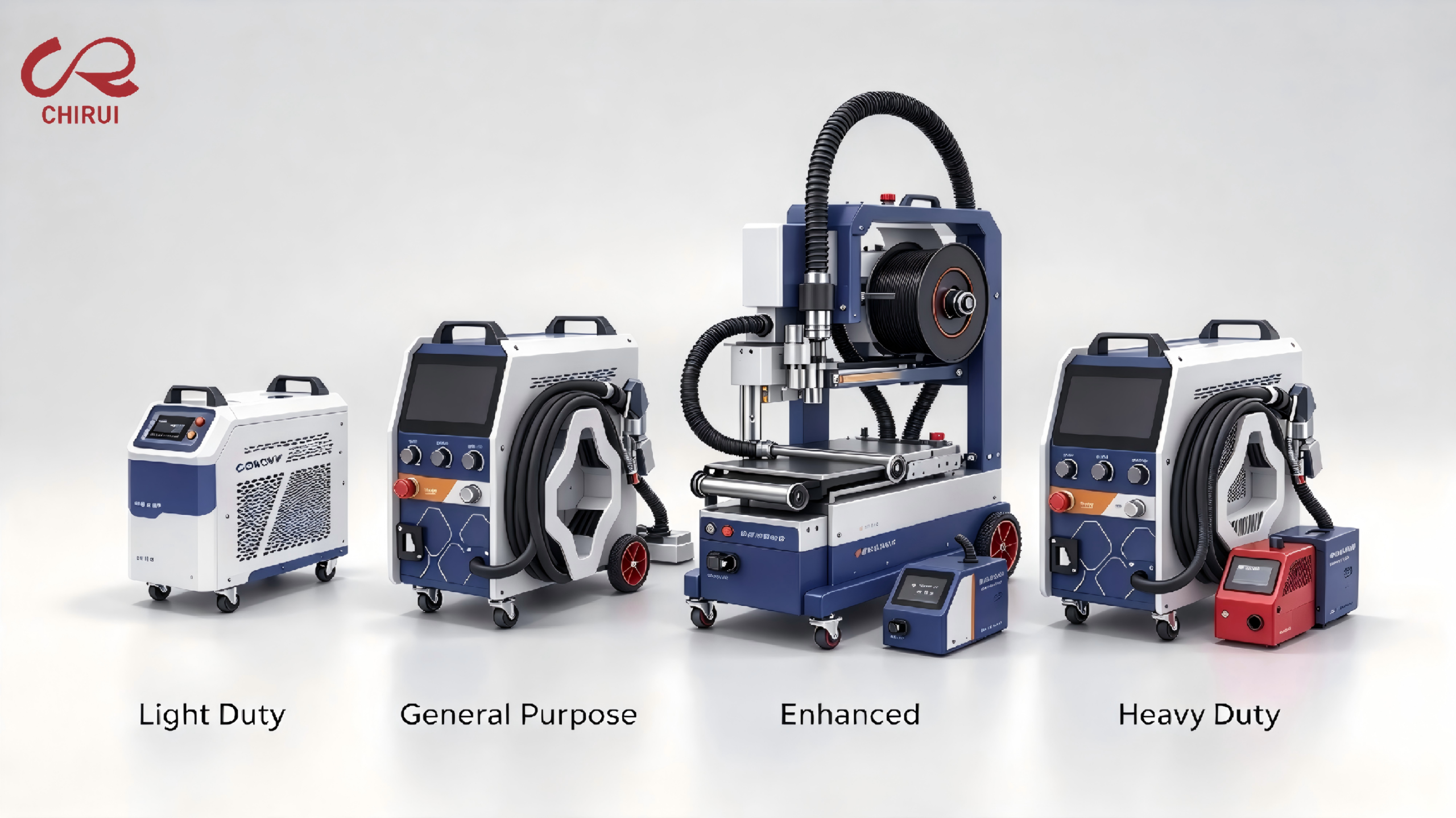
Based on common industrial application scenarios, mainstream laser welders fall into four performance tiers:
Entry-Level Light-Duty Tier
- Performance profile: Optimized for thin material precision welding, with low heat input and minimal workpiece distortion
- Ideal applications: Thin-wall hardware, door and window profiles, precision electronic components, and small kitchenware products
- Best for: Low-volume, high-precision production runs with thin gauge materials
General-Purpose Versatile Tier
- Performance profile: Balanced welding speed and process flexibility, the most widely adaptable power range for general industrial use
- Ideal applications: General sheet metal work, shelf manufacturing, ventilation ducting, and standard steel structure assembly
- Best for: Job shops and medium-batch production with mixed material thicknesses
Medium-Thick Plate Enhanced Tier
- Performance profile: Deeper penetration capability and higher travel speed, supporting sustained production throughput
- Ideal applications: Medium-thick sheet metal, heavy-duty shelving, machine frames, and agricultural machinery components
- Best for: Medium-to-high volume production with moderately thick materials
Heavy-Duty Industrial Tier
- Performance profile: Industrial-grade deep welding capability, capable of replacing traditional arc welding for many heavy applications
- Ideal applications: Thick-plate steel structures, heavy machinery, pressure vessels, and rail transit components
- Best for: High-volume heavy manufacturing requiring maximum penetration and productivity
2. Air-Cooled vs Water-Cooled Laser Welders: Scenario Fit Guide
The cooling system is the foundation of stable laser and optical performance, and it is the most commonly misselected feature in laser welder purchasing. Air-cooled and water-cooled designs are not “better or worse” — they are engineered for different operating environments.
Air-Cooled Laser Welding Series
- How it works: High-volume forced air cooling for the laser source and optical cavity, with no internal water circuit
- Core advantages: Compact integrated design, light weight, high portability; no coolant maintenance, no leakage risk, strong adaptability to harsh job site conditions
- Best fit: Non-stationary on-site work, outdoor repair jobs, multi-station rotational use; low-to-medium volume intermittent production
Water-Cooled Laser Welding Series
- How it works: Built-in closed-loop cooling system that precisely controls operating temperature of the laser and welding head
- Core advantages: Superior heat dissipation for continuous full-load operation; stable thermal control extends optical component life and delivers consistent weld quality
- Best fit: Fixed-station production lines, high-volume continuous manufacturing, high-precision welding applications; high-temperature factory environments
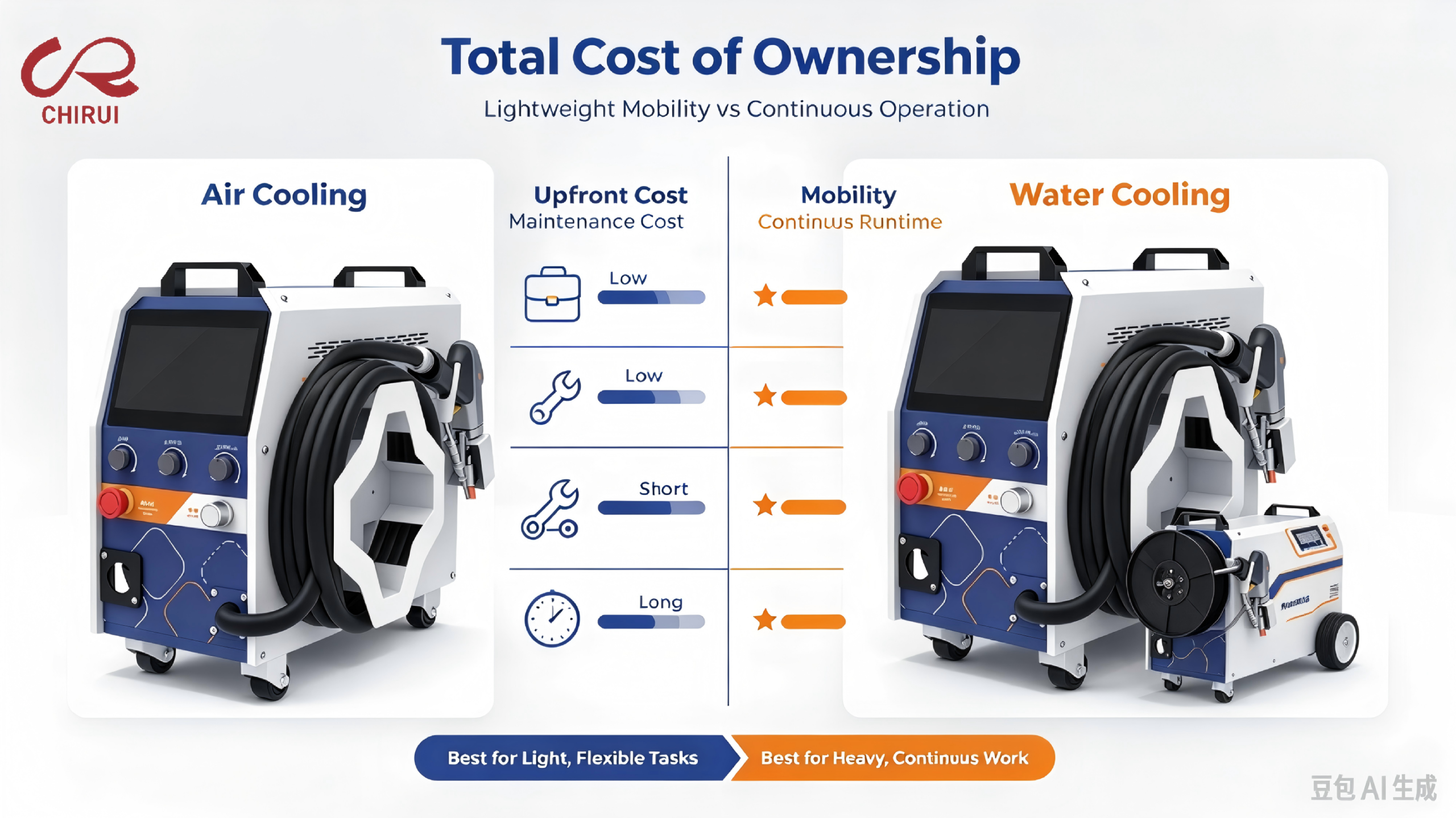
💡 Selection tip: For single-shift intermittent operation, air-cooled machines deliver the best return on investment. For multi-shift or around-the-clock production, water-cooled models provide superior long-term reliability and lower downtime risk.
3. On-Site Compatibility Checks Before Purchasing
Smooth deployment and reliable operation depend on matching machine specifications to your facility conditions. This step is frequently skipped, leading to costly installation delays and operational limitations.
Power Supply Compatibility
- Standard industrial single-phase power: Compatible with most small-to-medium power laser welders, plug-and-play with standard workshop outlets, minimal installation work required
- Heavy-duty three-phase industrial power: Required for high-power heavy-duty models. Always confirm your facility’s electrical capacity, cable specifications, and connector types before purchasing to avoid on-site installation failures.
Environmental Operating Limits
- Temperature range: Standard units operate reliably across typical industrial temperature ranges. Preheating procedures are recommended for cold winter environments, and extra ventilation is advised for high-temperature summer workshops.
- Humidity resistance: Standard models are rated for typical industrial humidity levels. High-humidity, high-salt spray, or corrosive atmospheric environments require customized protection to prevent optical component damage.
- Shielding gas requirements: Argon-nitrogen mixed shielding gas is standard for most applications. For oxidation-sensitive materials like aluminum and titanium alloys, higher purity argon and adjusted gas flow rates are required.
4. Function Configuration: Welding-Only vs Weld-Cut All-In-One
Most modern laser welders offer combined welding and cutting capability. Align your feature set with your actual workflow to avoid paying for functionality you will not use.
- Welding-only configuration Dedicated welding models have a simpler optical path, lower upfront cost, and lower light loss. Recommended for workshops focused exclusively on high-volume, single-process welding operations.
- All-in-one welding + cutting configuration Most mid-to-high end models include auxiliary cutting capability for thin sheet blanking, bevel trimming, weld cleanup, and rework cutting. This multi-functionality is ideal for job shops with mixed product lines and varied workflows.
⚠️ Important note: Cutting capability on a welding machine is designed for secondary auxiliary operations. If your primary workflow is cutting thick plate, a dedicated laser cutting machine will deliver better speed, edge quality, and component longevity.
- Filler wire compatibility All mainstream series support a range of filler wire diameters, adaptable to butt welds, fillet welds, lap welds, and other joint configurations based on gap size, penetration requirements, and finish standards.
5. Total Cost of Ownership: Hidden Factors Beyond Purchase Price
Smart equipment selection goes beyond upfront purchase price — it accounts for delivery, facility adaptation, and long-term maintenance costs.
Footprint & Facility Requirements
- Air-cooled models feature a compact form factor and light weight, making them easy to position on standard workbenches and move between work stations.
- High-power water-cooled units have a larger footprint and heavier build. Measure aisle widths, workstation space, and floor load capacity before ordering to ensure smooth delivery and placement.
Long-Term Maintenance Costs
- Air-cooled machines: No fluid consumables required. Routine maintenance is limited to periodic air filter and protective lens cleaning, with very low annual upkeep costs — ideal for smaller operations with limited in-house technical support.
- Water-cooled machines: Require periodic replacement of coolant and precision filters on a regular maintenance cycle, with higher annual consumable costs. However, they deliver longer laser and optical component service life, resulting in lower total cost of ownership in continuous production environments.
6. 5-Step Standard Selection Workflow for Industrial Buyers
Based on industry best practices and real-world deployment experience, follow this standardized process to minimize selection risk and maximize return on investment:
- Define your operational requirements first Document your base materials, typical thickness range, joint types, precision specifications, and daily production volume.
- Determine your performance tier Use your maximum welding requirements plus a reasonable power reserve to narrow down the appropriate performance category.
- Select your cooling system type Choose air-cooled or water-cooled based on your production schedule (continuous vs. intermittent) and work location (fixed vs. mobile).
- Verify on-site conditions Confirm power supply availability, available workspace, and ambient environmental conditions to eliminate installation and operational barriers.
- Validate with sample welding tests Run test welds on your representative workpieces to verify weld appearance, penetration quality, and mechanical strength meet your technical standards.
7. FAQ: Common Laser Welder Selection Questions
Q: How do I determine what power laser welder I need?
A: Start with your thickest workpiece material and required production speed. Always build in a reasonable power reserve to extend component life. For most accurate results, run sample welds with your actual parts.
Q: Is air-cooled or water-cooled laser welder better?
A: Neither is universally better. Air-cooled models are more portable and lower-maintenance, ideal for on-site and intermittent work. Water-cooled models offer better thermal stability for continuous production and higher performance tiers.
Q: Can a laser welding machine also cut metal?
A: Most mid-to-high end laser welders include auxiliary cutting function for thin materials and weld cleanup. However, cutting is a secondary feature — for primary thick-plate cutting operations, a dedicated laser cutter is more suitable.
Q: What materials can a laser welding machine weld?
A: Standard industrial laser welders work with carbon steel, stainless steel, galvanized sheet metal, and aluminum alloys. They can also be used with specialty filler wires for dissimilar material joining applications.
Q: What do I need to prepare before installing a laser welding machine?
A: Confirm your workshop power supply matches the machine requirements, prepare appropriate shielding gas supply, and ensure adequate workspace and ventilation. For water-cooled models, plan for regular coolant maintenance access.
Final Takeaway
There is no single “best” laser welding machine — only the best match for your specific production scenario. Overbuying on power and features wastes capital; underpowered or misconfigured machines create production bottlenecks and compromise quality.
Start with your actual process requirements, narrow down options systematically using the selection framework above, and validate with real sample welding to strike the optimal balance between performance and cost.
👉 Explore our full range of air-cooled and water-cooled laser welding solutions, or contact our technical team for a customized recommendation tailored to your fabrication needs.