
 Pick the wrong system and you’ll waste budget, slow down output, and risk damaging parts. Here’s how to make the right call.
In the industrial cleaning space, laser cleaning is steadily replacing traditional methods like sandblasting, acid pickling and mechanical grinding — thanks to its consumable-free operation, zero chemical pollution and high automation potential. Yet for many procurement managers and engineering teams, one question always stalls the buying decision: should you go with continuous wave (CW) laser cleaning or pulsed laser cleaning?
Choose wrong and you’ll not only lose efficiency, but also face issues like substrate deformation, surface damage and missed production targets. In this guide, we break down the core principles, pros and cons, and real-world selection criteria to help you decide.
Core Principles: Why They’re Not Just “Different Power Modes”
The difference goes far beyond output pattern — it’s the entire cleaning mechanism. This is the foundation of every buying decision.
Continuous Wave (CW) Laser Cleaning
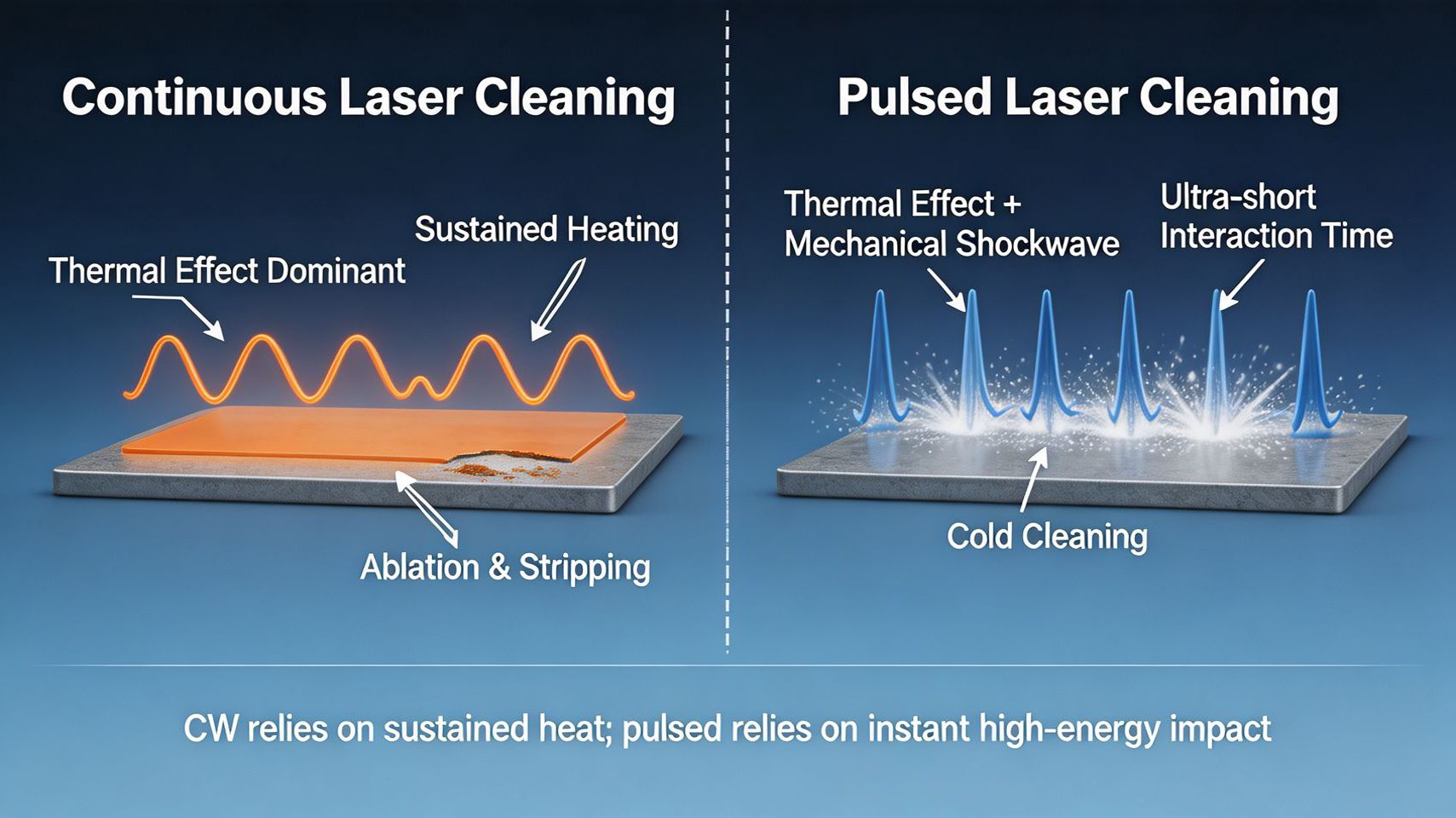
A CW laser delivers a constant, uninterrupted light beam. Its cleaning mechanism relies primarily on thermal effect: the laser beam continuously irradiates the contaminant layer, rapidly raising its temperature until the material melts, vaporizes or delaminates via thermal expansion from the substrate surface.
In short: sustained heating for ablation and stripping. Energy is input continuously, and the substrate heats up along with the contaminant.
Pulsed Laser Cleaning
A pulsed laser emits high-energy pulses in nanosecond or even shorter durations, delivering extremely high peak power with very brief interaction time. Its cleaning mechanism combines thermal effect + mechanical shockwave: the contaminant absorbs energy in an instant, vaporizes and ionizes into plasma that expands rapidly, generating a strong shockwave that blasts contamination off the substrate.
Because the pulse duration is far shorter than the thermal diffusion time, heat does not have time to conduct into the bulk substrate. This is why pulsed laser cleaning is often referred to as “cold cleaning”.
Full Comparison: Pros, Cons & Key Differences
| Comparison Factor | Continuous Wave Laser Cleaning | Pulsed Laser Cleaning |
|---|---|---|
| Heat-Affected Zone (HAZ) | Relatively large; prone to thermal discoloration and annealing | Minimal; nearly no thermal damage, close to cold processing |
| Cleaning Speed | Fast; high-power models reach dozens of m²/hour | Slower; ~1/10 to 1/20 the area efficiency of CW per unit power |
| Cleaning Precision | Lower; hard to control depth, risk of over-cleaning | Extremely high; micron-level precise layer removal |
| Substrate Damage Risk | Higher; thin materials prone to deformation / melting | Very low; non-destructive with properly tuned parameters |
| Compatible Materials | Mainly metals; ideal for thick plates | Versatile: metals, plastics, stone, wood, heritage artifacts, etc. |
| Equipment Cost | Lower; ~1/3 to 1/5 the price of pulsed at the same nominal power | Higher; peak power technology raises cost barrier |
| Operation Complexity | Simple; fewer parameters, easy for frontline staff to learn | Complex; requires tuning pulse width, frequency and energy |
| Best Contaminants | Thick rust, heavy paint, heavy oil, thick coatings | Light rust, oxide scale, oil film, residual plating, micro-particles |
Continuous Wave Laser Cleaning: Built for Heavy-Duty, High-Volume Work
Advantages
- High efficiency for large areas – Ideal for big workpieces like steel structures, pipes and ship hulls, with maximum throughput per hour.
- Strong on thick contaminants – Significantly outperforms pulsed systems on rust >100μm, multi-layer industrial paint and heavy coatings.
- Lower upfront cost – Much lower price point at the same rated power, lowering the barrier to entry.
- Simple operation & maintenance – Mature water-cooled design, minimal parameter adjustment, easy for on-site workers to operate.
Disadvantages
- Higher thermal damage risk – Leaves a heat-affected zone and blue/yellow oxidation discoloration; unsuitable for cosmetic or precision parts.
- Deformation risk on thin substrates – Sheets under 2mm can warp or change dimension due to heat buildup.
- Limited precision – Difficult to control cleaning depth accurately, with risk of over-etching the base material.
Pulsed Laser Cleaning: Built for Precision & Non-Destructive Work
Advantages
- Near-non-destructive cleaning – Negligible heat impact; does not alter substrate metallurgy or dimensional accuracy.
- Highly controllable precision – Removes micron-thick layers with pinpoint accuracy, ideal for precision molds and aerospace parts.
- Wide material compatibility – Safe for heat-sensitive materials including plastics, rubber, stone and wooden heritage objects.
- Air-cooled & portable – Low-to-medium power models are often air-cooled, lightweight and suitable for on-site mobile work.
Disadvantages
- Low throughput for large areas – Slow on thick layers and large workpieces, limiting production capacity.
- Higher equipment cost – 2–5x the price of CW systems at equivalent average power.
- Steeper learning curve – Requires optimized tuning of pulse width, frequency and energy for different materials and contaminants.
How to Choose: 4 Dimensions to Match Your Application
There is no universally “better” option — only the right fit for your scenario. Use these 4 criteria to narrow it down.
1. By Substrate: Thick & robust = CW; thin & precision = pulsed
- Choose CW: Thick steel plates (>5mm), cast iron parts, structural steel, construction machinery frames — heavy, heat-resistant metal workpieces.
- Choose pulsed: Thin sheets, precision parts, molds, aluminum/titanium alloys, non-metals, and parts with cosmetic or dimensional tolerance requirements.
2. By Contaminant: Thick & heavy = CW; thin & light = pulsed
- Choose CW: Heavy rust (>100μm), thick paint, asphalt, heavy oil, rubber residue and other thick, stubborn contaminants.
- Choose pulsed: Light rust, oxide scale, weld marks, thin oil films, mold release agent residue and micro-particles.
3. By Quality Requirement: Rough prep = CW; precision finish = pulsed
- Choose CW: Pre-treatment before painting, structural refurbishment, corrosion removal — applications where slight thermal discoloration is acceptable.
- Choose pulsed: Food/pharmaceutical equipment, aerospace components, automotive tooling, heritage restoration, electronics — zero thermal damage and high precision are mandatory.
4. By Capacity & Budget: High volume = CW; high value = pulsed
- Choose CW: High-volume contract cleaning businesses, output-focused operations, and limited capital budgets.
- Choose pulsed: High-value component cleaning, precision manufacturing processes, and applications where quality outweighs speed.
Industry-by-Industry Selection Reference
| Industry / Application | Recommended Type | Key Reason |
|---|---|---|
| Steel structure rust removal, ship paint stripping | CW Laser | Large areas, thick coatings, speed priority, acceptable HAZ |
| Construction machinery refurbishment, pipe maintenance | CW Laser | Heavy workpieces, heavy contamination, efficiency first |
| Rubber molds, injection mold cleaning | Pulsed Laser | High precision required, no damage to cavity surface |
| Aerospace component cleaning | Pulsed Laser | Material-sensitive; zero thermal deformation or metallurgical change |
| Heritage restoration, historic building cleaning | Pulsed Laser | Extremely high non-destructive requirement; diverse fragile materials |
| Food & pharmaceutical equipment cleaning | Pulsed Laser | No residue, no thermal damage, meets hygiene standards |
| Hardware weld mark & oxide cleaning | Pulsed Laser | High cosmetic requirement; must retain original surface finish |
3 Common Misconceptions to Avoid
Myth 1: Higher power is always better
Many buyers only look at wattage and assume 1000W is always better than 500W. In reality, cleaning performance depends on matching energy density to interaction time, not raw power alone. Too much power causes substrate damage; too little leaves contamination. Always select a power range matched to your contaminant and substrate.
Myth 2: Pulsed lasers can replace CW lasers
Pulsed systems offer higher precision and non-destructive cleaning, but they cannot match CW for speed or thick-layer removal. For large-area, heavy-coating jobs, forcing a pulsed solution cripples throughput and drives up per-unit cleaning cost. The two are complementary, not interchangeable.
Myth 3: CW lasers always damage the substrate
CW lasers do create a heat-affected zone, but by controlling scan speed, spot overlap and power density, you can limit HAZ to acceptable levels. For steel plates over 5mm, properly parameterized CW laser cleaning fully meets pre-painting requirements without compromising structural integrity.
Final Takeaway
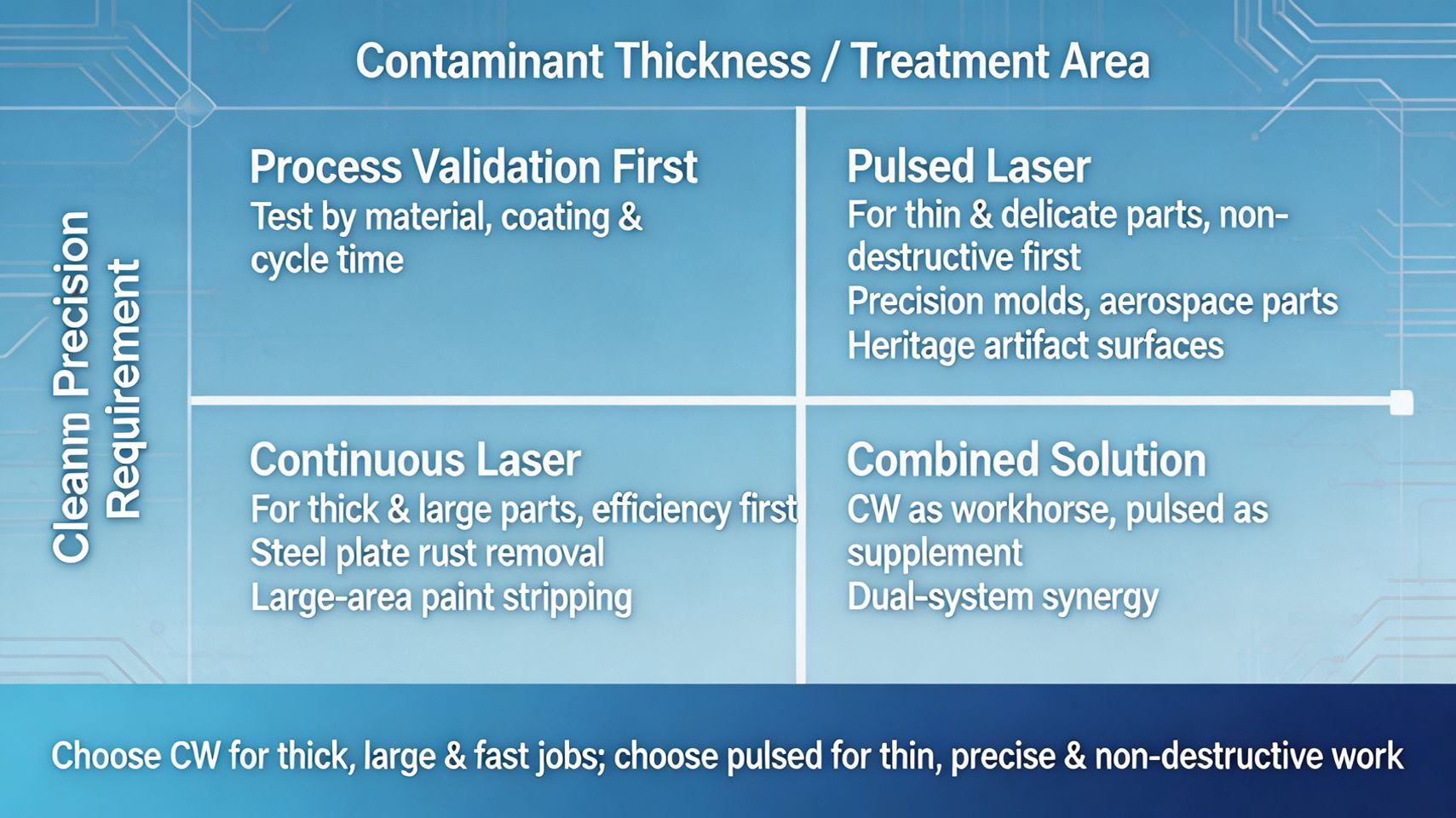
A simple rule of thumb: Go CW for thick, large, rough and fast jobs; go pulsed for thin, small, precise and non-destructive work.
If your business covers both high-volume rough cleaning and precision part orders, consider a combined setup — CW laser cleaning as your workhorse, pulsed laser cleaning as your precision supplement — to balance efficiency and quality.
Laser cleaning selection is not about picking the highest power. It’s about choosing the system that best matches your substrate, contaminants, quality requirements and production goals.
Need Help Choosing the Right Machine?
If you’re not sure whether continuous wave laser cleaning or pulsed laser cleaning is better for your application, our engineering team can help you compare performance, throughput, operating costs and return on investment.
We support both standard configurations and customized solutions for different industrial cleaning tasks.
👉 Contact us today to discuss your cleaning requirements and get a recommended machine configuration.